
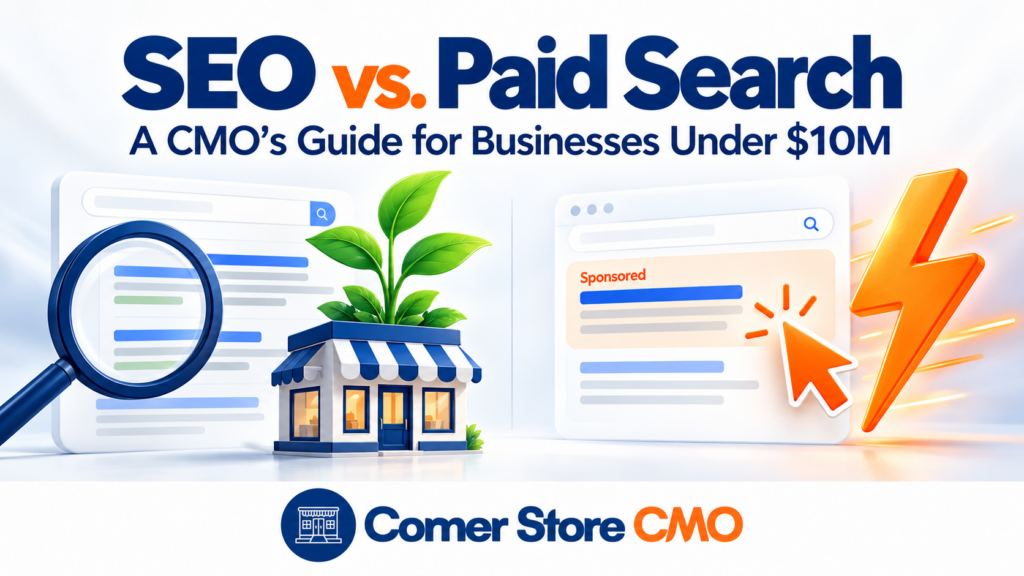
“Should we do SEO or Google Ads?” It’s one of the most common questions I get from small business owners, and the answer is almost always “it depends on your timeline, your margins and your market.” Here’s how I think about it.
How they differ
Paid search (Google Ads, Microsoft Ads) puts you at the top of results today. You pay for each click. When you stop paying, the traffic stops.
SEO (search engine optimization) earns you a place in the free, organic results. It takes months to build, but the traffic keeps coming without a per-click cost, and it also helps you show up in AI search answers.
A simple way to remember it: paid search is renting, SEO is owning.
When paid search makes sense
- You need leads now: a new business, a new location, or a slow season.
- Customers search with urgent intent (“emergency plumber near me”).
- Your profit per customer comfortably covers the cost per lead.
- You want to test which messages and offers convert before investing in content.
When SEO makes sense
- You can be patient for three to twelve months.
- Customers research before they buy and ask lots of questions.
- Clicks in your category are expensive.
- You want an asset that compounds over time instead of a monthly bill.
The answer for most small businesses: both, in the right order
For most businesses under $10M, I recommend a blended approach:
- Start paid search narrow. Focus on your highest-intent keywords and your most profitable service. Use tight geographic targeting and lots of negative keywords so you don’t pay for the wrong clicks.
- Build SEO underneath it. Use the search terms report from your ads to learn which phrases actually turn into customers, then create pages that target them organically.
- Shift budget over time. As organic rankings grow, you can often reduce paid spend on terms where you rank well and redirect it to new tests.
Mistakes I see most often
- Running Google Ads with broad match and no negative keywords
- Sending ad clicks to the homepage instead of a focused landing page
- Hiring for “SEO” without knowing which keywords or which pages are being worked on
- Not tracking calls and forms, so nobody knows which channel is working
The bottom line
SEO and paid search aren’t competitors. They’re two halves of one search strategy. The right mix depends on your numbers, and that’s exactly what a Corner Store CMO will tell you.